You too have specific needs depending on the context you are in, but on a general level the needs are more common than we think 🙂
Regardless of whether you are a solopreneur, freelancer or entrepreneur, you certainly find yourself and have the following 3 basic needs:
You need to earn more money
You need to be more efficient
You need clarity
And in this article we’re going to dive deeper into all of these 3 basic needs so you can understand even better how all the actions you take start from here.
And once you understand that, you’ll know for sure what decisions you need to make to meet those needs.
But before we go into each one and point things out for you, I’d like to clearly define the needs and understand where they really come from.
Basically you got to where you are now because of motivations deeper than money, efficiency and clarity.
And here we will refer to the “Why” behind.
Discover Zemers
A web platform where you sell digital products: courses, communities, online sessions and valuable content.
In 2009, author Simon Sinek first introduced the concept of “Start with Why” with the publication of his book of the same name.
This concept quickly became popular and was detailed in his 2009 Tedx Talk entitled “How Great leaders inspire action”, which became one of the most watched Ted Talks of all time.
This idea has captured the attention of leaders and entrepreneurs around the world because of its simplicity and power to transform the way we think about leadership and business.
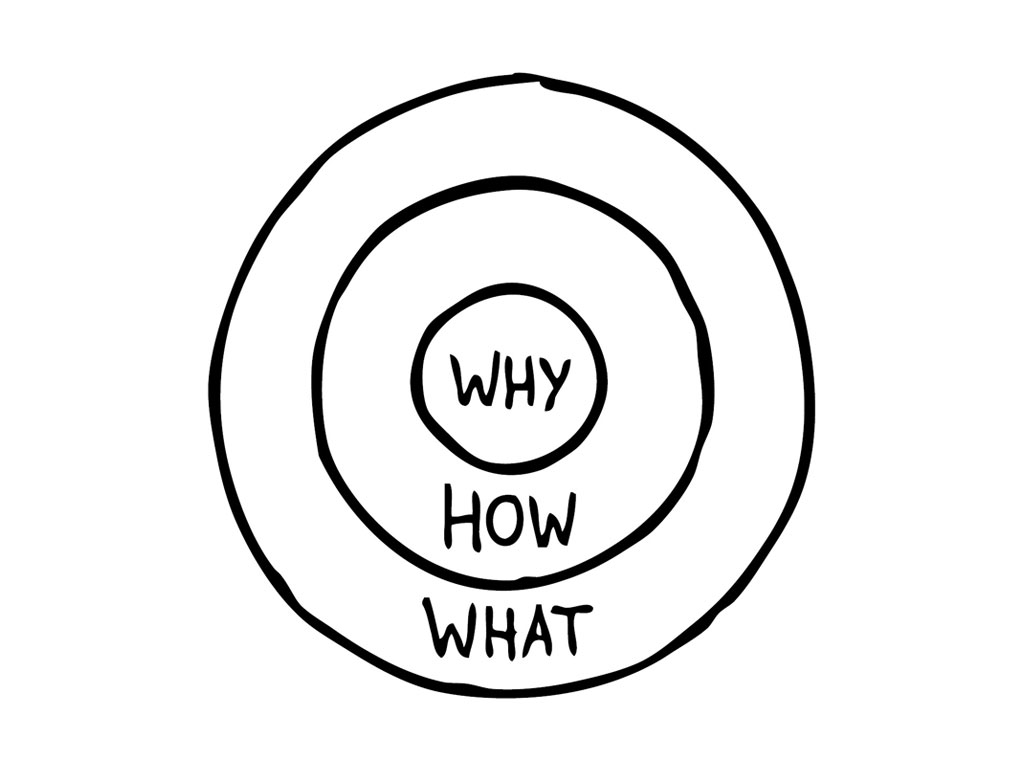
The concept is centered on the idea that successful leaders and organizations always begin their work with a deep clarification of why they do what they do, before addressing how and what they do.
The key elements of the concept are:
1. The Golden Circle:
Why: This is the cause, belief or central purpose of an organization. It is the reason the organization exists beyond profit. Successful leaders and companies begin their work by clearly defining their “why”.
How: This refers to the process or values that make an organization unique and enable it to achieve its “why”. It is about how the organization accomplishes its mission.
What: This is the most obvious part and refers to the products or services that the organization offers. Most companies start here, but inspired leaders always start with “why.”
2. The power to inspire:
Sinek argues that people don’t just buy what you do, they buy why you do it. Inspiring leaders are those who clearly communicate their “why,” creating an emotional connection and deep loyalty.
The classic example used by Sinek is Apple. Apple promotes itself not just by what it makes (computers, phones), but by why it does it – to challenge the status quo and bring innovation.
3. Applicability in leadership and business:
Leaders and organizations that start with “why” are better able to motivate and inspire employees, customers and partners, leading to long-term success.
This approach not only helps to differentiate in the market, but also to create a strong and authentic organizational culture.
Why the concept of “Start with why” is beneficial
It gives you clarity of purpose and mission
It helps you create a strong and coherent organizational culture
Help inspire and motivate your employees and customers
It helps develop an authentic and effective marketing strategy
Free training
How to build a simple, profitable online business around what you know.
Here I will present you another basic concept in the business world that you should know:
Maslow’s Pyramid of Needs
Maslow’s pyramid of needs, also known as Maslow’s hierarchy of needs, is a psychological model proposed by Abraham Maslow in 1943 to describe human motivation.
Maslow suggested that people have five levels of needs, organized in a hierarchy, from the most basic to the most complex. Each level must be satisfied before moving on to the next. Here is a detailed explanation of each level:
Physiological needs:
These are the basic needs required for the physical survival of the individual.
Examples: Air, water, food, shelter, sleep, clothing and reproduction.
Safety needs:
Once physiological needs are met, people seek to ensure physical and emotional safety.
Examples: Personal safety, financial stability, health, protection against accidents and diseases.
Love and Belonging Needs:
After safety needs are met, people want to form social relationships and feel part of a group.
Examples: Friends, intimate relationships, family, membership in communities and social groups.
Esteem needs:
These needs involve recognition and appreciation of self and others.
Examples: Self-respect, recognition, status, prestige, success, achievement and appreciation from others.
Self-updating needs:
This is the highest level of Maslow’s pyramid and represents the realization of the individual’s maximum potential.
Examples: Personal development, creativity, achieving personal goals, vocational fulfillment, self-expression and seeking new experiences.
So, with these 2 concepts in mind, if you were to introspect, what do you think are the real reasons behind why you have the 3 needs highlighted at the beginning?
Here’s a short list of general motivations I thought of:
flexibility
good life
STATUS
freedom
self realization
autonomy
timely
personal satisfaction
control
diversity
creativity
balance
financial independence
exploring personal passions
various professional connections
own rules
satisfaction of directly seeing the impact of one’s own achievements
developing your own vision
diversification of sources of income
implementation of own values
own decisions
Now, based on this list it will certainly be easier for you to clarify what your intrinsic motivations are.
1,173 readers
Andrei's Newsletter
Insights on marketing, systems and business growth strategies for founders and experts.
No spam. You can unsubscribe anytime.
Maybe you’re a person who likes to play by your own rules. Or maybe you want more autonomy. Or you have a deep need to achieve a status in society.
The point is that the items listed above can also be inspected at an even deeper level.
Here we are already talking about searching at the subconscious level.
You see, all our needs are closely related to our past, specifically the first 7 years of life.
During these years you lived in a certain environment and assimilated different behaviors, needs and desires from your family and from that context.
Unfortunately, in many cases it happens that in childhood we suffer some psychological traumas that we repressed in the depths of our subconscious (or more easily said: if you relived a strong feeling of fear/isolation/agony/etc., you buried that feeling deep in your brain and you grew up with it).
The problem is that many times we do things that we don’t realize precisely because we have buried at an unconscious level these problems from the past that affect our behaviors.
For example, if you experienced something intensely negative in the past, you may now be affected by it. Maybe that’s why you are more introverted, withdrawn and have different fears.
Or maybe that’s why you feel the constant need to show off in front of people to show them who you are and how cool you are.
And the examples can go on.
The point is that our identity is a large part of life influenced by the contexts in which we lived and grew up. We are programmed from a young age to obey systems and rules. We are indoctrinated and trained in a certain posture to avoid thinking critically or to rebel against certain things because of fear for example.
And not to stretch too much on the subject, I just want to make you aware that there may be such occurrences that affect your life and behaviors in the present.
The good news is that every problem has a solution.
And to solve a problem you have to be aware of its existence.
So, do these introspection exercises and try to find out the real motivation for doing what you do.
Discover your limitations and barriers and then dig deeper to be able to surface them.
Once you do this you will be able to find solutions to solve them and then you can reach your true potential.
I say these things because it’s about mindset.
„Success is 95% mindset and 5% strategy”
And most business people have a mindset problem and because of their very strong ego, they don’t want to admit that they might have a mindset problem.
Mindset is very much about the perspectives you adopt and how open you are to adopting better ideas/concepts to help you evolve.
Because what happens in your life and business is directly proportional to the mindset you have.
And if you grew up in an environment of closed-minded and narrow-minded people, poor in knowledge, finances and specific actions, it may be difficult for you to make a meaningful change. But it is not impossible.
So, let’s go back to the 3 needs we started with.
1. The need to earn more money
If you’ve done your homework, you already know why you need this.
Money is the fuel of the society we live in and is a result of our actions.
Money should not be seen as a goal or as a source of motivation. They are simply a medium of exchange.
What do you need to do to earn more money?
There are 3 simple things generally valid in any business/field:
to sell more expensive
to sell more
to keep customers loyal
Let’s take them one by one:
Sell more expensive
In order to be able to sell more expensively, you need to increase the level of confidence of your potential customers and decrease their level of reluctance.
To do this you can call:
social proof (many post likes, many followers, many positive comments, many good reviews, etc.)
evidence of what you offer (warranty certificates, quality certificates, diplomas, awards, prizes, videos showing
exactly what you offer,
positive reviews/testimonials
provide clarity
provide transparency
proof that you are an authority in your field (through your expertise and experience; offer trainings, offer
meetings, offer consultancy, offer guides or different materials to certify that you know what you are talking about)
you have consistency and congruence in what you present (i.e. you are constant with the same offers and ideas,
you don’t change offers or approaches frequently, you stick to the same principles, you don’t move from one field to another, etc.)
Sell to more customers
That’s why you need to promote yourself to attract as many potential customers as possible.
At the same time, you must systematize your activity so that you can deal with more clients in terms of your time, energy and resources.
In order to sell more, you have to constantly adapt to changes and needs in the market because that way you can attract people who are interested in what you have to offer, being something more up-to-date than something old that they can get rid of.
Build customer loyalty
To keep customers loyal, you need to increase your performance:
increase the speed of delivery
improves the quality of services/products offered
improves team efficiency
increase customer satisfaction
communicate effectively
provides clarity and predictability in actions
achieve good and satisfactory results
respect deadlines
helps the client achieve their goals
secure the customer’s dependence on your business
Online coaching program
You are guided to build a profitable online business around your knowledge.
allocate fewer resources and maintain quality/performance
To be more efficient you need 2 essential things:
To improve productivity and the way you work and your personal systems
To have balance between personal and professional life
Improve the way you work and your personal systems
To be able to improve your way of working and your personal systems and productivity, you have 2 other options:
You inform yourself to see how others are doing and adopt from them
You test your own methods and choose the optimal option for you
Now of course you have many options and you can’t do them all right the first time.
For all this area of education/information you need to allocate a lot of time and energy.
I recommend a combination of the 2 options for the following reasons:
it is very good to adopt functional systems made by others and not reinvent the wheel
it is important to adapt whatever you see to your own context and take into account the context in which a method/strategy/system can be applied
For example, yes, it is good that you read books and look for information on Youtube.
It is very good to be self-taught and do your own research.
It is even better to buy ready systematized and structured courses to make your documentation activity even more efficient and to have more clarity (because often the problem when we do our own research is that it takes a lot of time and the information is very divided into hundreds of different sources and until you reach a tangible and functional conclusion you have a long way to go).
But keep in mind that every person who gives you information for a fee has the same needs as you. That’s not a problem. The problem arises when you take information from imposters, that is, people who do not have results and expertise in a field. Pay attention to this.
In other words, with the passage of time you will improve your own skills and come to your own conclusions and perfect systems for you.
Don’t believe everything you see on the internet.
Take any information sprinkled.
Adapt everything to your own context.
Understand things from multiple perspectives.
Achieve balance between your personal and professional life
Here it depends a lot on how your life is currently.
If you are always full of projects and working very hard and have many responsibilities, my first recommendation is to do your best to find a time to take a break.
But this break should not be a definitive one.
That is, not taking a break from work at all, but taking a break from working in your business.
I want you to take this time to work on your business and yourself.
During this time, do an introspection on the current situation:
see what’s good
see what’s wrong
see what pleases you and what doesn’t
see what you can optimize
see what you can give up
see what you can automate and automate
get rid of redundant tasks or delegate them
document yourself and study how you can improve what seems shaky or what needs improvement
Many problems arise only because you are actually in too much work and have no time to breathe. You don’t have time to research the market.
You don’t have time to educate yourself, to evolve.
You don’t have time to make new connections and partnerships.
And this will lead you to a state of monotony and eventual discomfort, or even worse: stress, anxiety.
And beyond stress and anxiety, there are frustrations, problems with business and personal relationships, health problems, and everything is in a chain.
All of this can happen when you live out of balance.
To improve, here’s what you can do:
improve time management skills
improves task and project management skills
take breaks
do sports
some rest
say “No” when you feel the need or when you have to
be very focused on what is most important
don’t lose focus
don’t do repetitive work, delegate it
don’t work overtime unless necessary
have a stable schedule
don’t overlap your tasks
don’t take more than you can carry
take care of yourself so you can take care of the rest
3. The need for clarity
I realized that many people have a problem with sharpness and I have had it many times myself.
These problems arise because we are constantly exposed to too much information and it seems that we have a lot of options, but in reality it is an illusion.
You can’t be alive and a very good doctor and a lawyer and a fireman and a minister…
You have to choose a direction from the beginning and go for it. But I will immediately give you the solutions that I have identified.
The fact is that often the lack of clarity can also be due to ignorance. And this not knowing means uncertainty, and uncertainty means unpredictability, and that leads to anxiety and stress.
But that’s how it is in business. The environment is very dynamic and things evolve quickly.
It’s hard to always have predictability.
Sometimes this can also be a hindrance.
Some people have a very strong need to be in control, and this puts a damper on their wheels.
But to be clear, here’s what you can do:
Get to know each other very well
To know the market and market needs + market dynamics
To clearly define your goals and direction
Discover Zemers
A web platform where you sell digital products: courses, communities, online sessions and valuable content.
In order to know yourself very well, I recommend that you understand your “ikigai”.
Ikigai is a Japanese concept that refers to why you get up in the morning.
For more details on the subject, I recommend the article: How to choose your path in life
Even if you have already chosen a path in life, read this article to learn some new concepts that you may not have known. And then keep them in mind.
To know yourself very well you must:
know what you like (make a list)
know what you don’t like (make a list)
to know your motivation behind and the deep needs you have (ie “Your Why”)
That’s about it in a nutshell.
If you do this it will help you for the rest of your life.
The point is not to have millions of information about what to do and how to do it. You only have a few. What is more important is what you do with this information.
Many who read never apply what they read.
Don’t be one of these people.
He knows the market, the needs and the dynamics
Document what others are doing and how they are doing it.
Build partnerships with others.
Join communities or clubs on different fields.
Take with you people who inspire you and from whom you can learn.
Do market research. “Spy” on what others are doing.
Reverse engineer what others are doing to understand why they are doing what they are doing.
It identifies the needs, frustrations, wants and problems in the market.
Identify what is changing in the market and try to predict what may happen in the future (especially with all this AI).
Or simply think of yourself from the past. You can be your own ideal customer avatar. Think about what you went through to be who you are now. Think about what challenges you had, what desires you had, what problems you had. And I assure you that there will be many who want to learn from you and turn to your solutions because they find themselves among these ranks.
Or another idea: imagine you are your customer and think about all the challenges, problems, needs, motivations, frustrations, desires behind it and reverse engineer it again to find the right solutions.
Define your goals and direction
Clearly define:
where you want to go
how much money you want to earn (hourly, monthly, annually)
how many customers you need to have and how much each customer should be worth
the amount of products/services you have to sell
define target audience and customer avatars
make a concrete plan to achieve these goals
define the resources you have
define what else is needed and you don’t have now
define what you have to do to get certain resources
define limits/barriers so you know how far you can take it and know what you have to overcome in the future
what an ideal day in your life looks like
what your customers and working with them must be like
what your ideal team and your business ideally look like
Play with your imagination and be very specific. That’s the only way you’ll know where you’re going and why you’re doing it.
Success!
1,173 readers
Andrei's Newsletter
Insights on marketing, systems and business growth strategies for founders and experts.